Activating self-awareness leads to better emotional management, improved communication, stronger relationships, more effective decision-making, increased confidence, greater personal happiness, and enhanced career success by helping you understand your strengths, weaknesses, emotions, and patterns of behavior.

Category: 111 Activate Your Self-awareness (Page 18 of 31)

10 Questions to Test your Relationships with based on the book

Relationship Self-Awareness Test

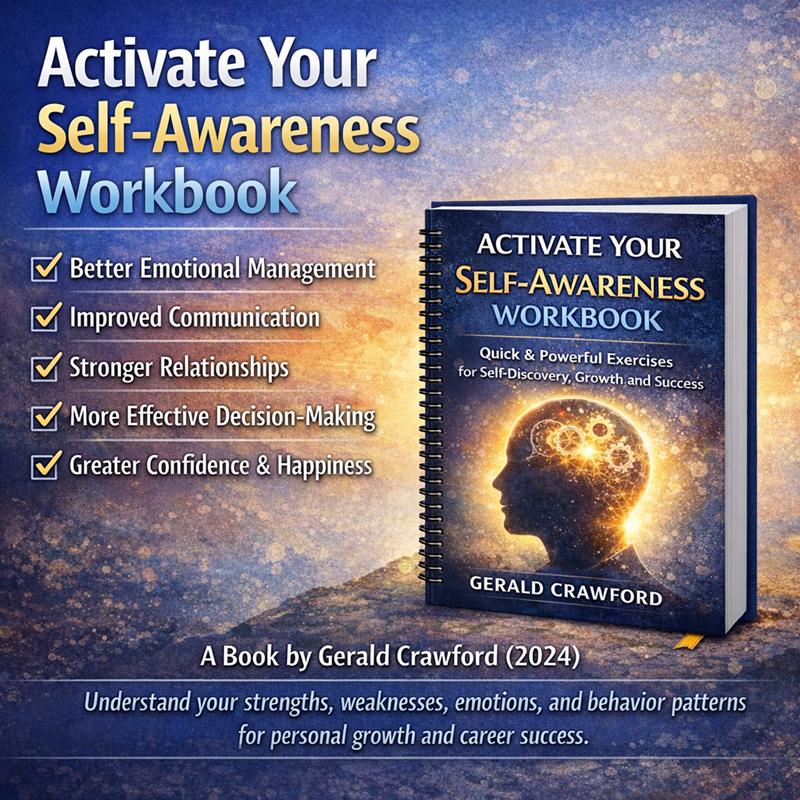
Based on Activate Your Self-awareness Workbook – Gerald Crawford (2024)


Instructions:

Answer each question honestly on a scale of 1–10
(1 = Not at all true, 10 = Completely true)


The 10 Questions

1. Self-Awareness

How aware am I of my own thoughts, emotions, and behaviors within the relationship?


2. Emotional Control

When triggered, how well do I manage my emotions instead of reacting impulsively?


3. Responsibility

Do I take responsibility for my actions, or do I mostly blame my partner?


4. Communication

How clearly and honestly do I express my feelings and needs?


5. Listening

Do I truly listen to understand my partner, or do I listen to respond?


6. Triggers

How well do I understand what triggers me and why?


7. Patterns

Am I aware of repeated negative patterns in our relationship—and my role in them?


8. Empathy

How well do I try to understand my partner’s perspective and emotions?


9. Effort & Growth

Am I actively working on myself to improve the relationship?


10. Connection

Do I consistently show appreciation, care, and emotional presence toward my partner?


Scoring Your Results

Add your total score (out of 100)


0–40: Disconnected & Unaware

There is a significant lack of awareness and emotional connection.
Focus on self-awareness and emotional responsibility first.


41–70: Inconsistent & Reactive

There is effort, but patterns and reactions still dominate.
Focus on communication and emotional triggers.


71–85: Growing & Improving

You are becoming more aware and intentional.
Continue building consistency and deeper understanding.


86–100: Conscious & Connected

You are operating at a high level of awareness and relationship maturity.
Maintain and deepen your connection.


Final Reflection

Complete this honestly:

  • The biggest thing I need to improve is: __________
  • One behavior I will change starting today: __________
  • One thing I appreciate about my partner: __________

Closing Insight

Your relationship will only grow
to the level of your awareness.

When you change how you show up…
everything begins to change.


Remember:

A better relationship starts with a more aware version of you.
Free Short Guide to Reconnect, Healing and Repair Relationship based on the book

FREE GUIDE

Reconnect, Heal & Repair Your Relationship

Based on Activate Your Self-awareness Workbook – Gerald Crawford (2024)


Introduction

Most relationships don’t break because of a lack of love.
They break because of lack of awareness.

Miscommunication… emotional reactions… repeated arguments…

These are not the real problems.

They are symptoms of something deeper:

Unseen patterns, unhealed emotions, and unconscious behavior

This guide will help you begin the journey of:

  • Reconnecting with your partner
  • Healing emotional triggers
  • Repairing your relationship through self-awareness

Step 1: Become Aware of Your Patterns

Before you look at your partner… look at yourself.

Reflect:

  • What do I repeatedly complain about?
  • How do I react during conflict?
  • Do I shut down, attack, or avoid?

Insight:

You don’t just experience the relationship—you co-create it.


Step 2: Understand Your Emotional Triggers

Every strong reaction has a deeper root.

Ask yourself:

  • What exactly triggered me?
  • What emotion did I feel?
  • When have I felt this before?

Insight:

Your partner often triggers what is already unhealed.


Step 3: Shift How You Communicate

Most couples don’t communicate—they react.

Use this simple formula:

  • “I feel ______ when ______ because ______.”

Instead of:
“You never listen to me!”
Try:
“I feel unheard when I’m interrupted because I need to feel valued.”

Insight:

Clear communication creates connection. Blame creates distance.


Step 4: Practice Conscious Listening

Listening is not waiting to speak.

Practice:

  • Listen without interrupting
  • Don’t defend—just understand
  • Reflect back: “What I hear you saying is…”

Insight:

Feeling understood is more powerful than being right.


Step 5: Take Responsibility (Not Blame)

Healing begins when you stop pointing fingers.

Complete this:

“In this relationship, I take responsibility for ________.”

Insight:

You cannot control your partner—but you can take control of yourself.

« Older posts Newer posts »

Step-up and get your seat on my VIP Activate Your Self-awareness Mentorship Program for 2026

X
Back a Buddy Show your Support