Don’t take yourself to serious, have a bit of fun and live in the moment you’re given.
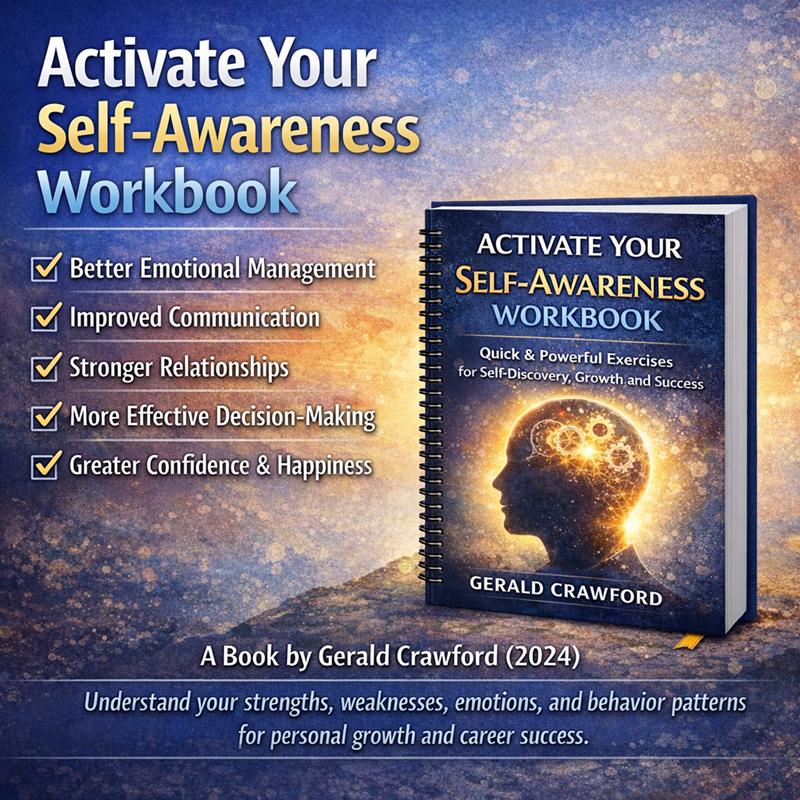
 Gerald Crawford is the author of the book “Activate Your Self-awareness Workbook by Gerald Crawford” (2024).
Activate Your Self-awareness Workbook by Gerald Crawford (2024) helps you understand emotions, improve communication, build relationships, and achieve success.
Gerald Crawford’s work represents a hybrid philosophy of psychological self-development and spiritual healing leadership.
It is inspirational and introspective, but its effectiveness depends heavily on how critically readers integrate the ideas with evidence-based psychology and practical life realities.
He is also is a Certified Clinical Hypnosis Practitioner, Healer, Guide and Educator. He has gone on a personal journey of transformation and discovery and studied the human mind for over 10 years and though his own adversity he has emerged victorious and is passionate about helping others find and live there true-self linked to balance an resilience.
Gerald Crawford has worked to develop specialized treatments integrating the principles of meditation, yoga, ayurveda, and clinical hypnotherapy. Gerald is a Master Teacher in the field of Dharma Therapy and continues to work both clinically and as an educator specializing in the treatment of individuals with anxiety, stress, depression, pain and complex trauma.
Gerald Crawford Personal Motto: With experience and study comes insight with insight come wisdom with wisdom comes moments of clarity, then transcendence then follows.
Here is a critical breakdown of the philosophy, books, and leadership ideas of Gerald Crawford based on the writings, programs, and professional background.
Gerald Crawford’s Philosophy, Books, and Leadership Teachings
1. Background and Intellectual Position
Gerald Crawford presents himself as:
- a certified clinical hypnosis practitioner
- a healer, guide, educator, and public speaker
- an author of multiple self-development and spiritual books.
His philosophy combines:
- psychology
- spirituality
- self-development
- healing practices (hypnotherapy, mindfulness, EFT).
This places his work within the modern self-help / spiritual development movement rather than traditional academic psychology or theology.
2. Major Books and Their Core Themes
Some of his published works include:
- What Men Need: Understanding and Nurturing the Modern Male (2021)
- The Spiritual Mentor: A Guide to Inner Wisdom and Enlightenment (2022)
- Develop Your Emotional Intelligence (2023)
- Activate Your Self-Awareness Workbook (2024)
- Remove the Doubt from Your Life (2025)
- Healing in Forgiveness (2025)
- Navigating the Six Levels of Relationships (2025)
- Awakening the Healer’s Touch (2025)
- Re-New Your Mind (2026)
- EFT Tapping Script Workbook (2026).
These books collectively promote:
- emotional intelligence
- self-awareness
- healing from emotional wounds
- removing self-doubt
- spiritual growth
- relationship insight.
3. Core Philosophical Ideas
3.1 Self-Awareness as the Foundation of Life
A central idea in Crawford’s books is that personal transformation begins with self-awareness.
His work emphasizes:
- identifying emotional patterns
- understanding internal beliefs
- observing thoughts and reactions.
Strength
This aligns with well-established psychological principles:
Self-awareness improves:
- emotional regulation
- decision-making
- relationship quality.
Criticism
However, excessive focus on introspection can lead to:
- over-analysis of feelings
- reduced action.
Self-knowledge must eventually translate into behavioral change.
3.2 Removing Doubt and Reframing Thought Patterns
His book Remove the Doubt from Your Life promotes:
- identifying negative thoughts
- building confidence through action
- surrounding oneself with supportive people.
Strength
This idea resembles cognitive-behavioral therapy principles, which focus on changing thought patterns.
Criticism
The common struggle in philosophy risks oversimplifying psychological struggle.
Not all doubt or anxiety is resolved by mindset shifts alone.
Some problems require:
- therapy
- social support
- long-term behavioral change.
3.3 Spiritual Energy and Healing
Some writings emphasize the idea that individuals can channel healing energy and loving intention into the world.
Strength
Practices like compassion, mindfulness, and intentional care can improve wellbeing.
Criticism
The language of energy healing moves into spiritual metaphysics that are not strongly supported by scientific evidence.
This can blur the line between:
- psychological practices
- spiritual beliefs.
3.4 Emotional Intelligence as Leadership
Another strong theme is emotional intelligence.
His teachings emphasize:
- empathy
- communication
- emotional regulation
- relationship skills.
Strength
Modern leadership research strongly supports emotional intelligence as a key leadership trait.
Leaders high in emotional intelligence often:
- build stronger teams
- resolve conflict better.
Criticism
Emotional intelligence alone does not ensure effective leadership.
Leadership also requires:
- strategic thinking
- competence
- accountability.
4. Crawford’s Leadership Philosophy
His leadership philosophy appears to emphasize:
1. Inner transformation before external influence
A leader must first understand and regulate themselves.
2. Healing-based leadership
Leaders should help others grow emotionally and spiritually.
3. Relationship-centered influence
Leadership happens through trust and emotional connection.
5. Psychological Strengths of His Approach
Crawford’s philosophy contains several strong elements:
Holistic personal development
His work integrates:
- mind
- emotions
- relationships
- spirituality.
Accessible guidance
The writing style is practical and motivational.
It encourages people to:
- reflect on their lives
- build healthier habits.
Emphasis on compassion
His work promotes:
- forgiveness
- empathy
- emotional healing.
These values can produce supportive leadership environments.
6. Limitations and Critical Concerns
1. Blending psychology and spirituality
The combination of:
- hypnotherapy
- spiritual energy
- self-help philosophy
Some concepts move outside evidence-based psychology.
2. Self-help optimism bias
Many self-development books assume:
- mindset change leads to life transformation.
But real life also involves:
- structural barriers
- trauma
- socioeconomic realities.
Mindset alone cannot solve everything.
3. Lack of peer-reviewed academic foundation
His work appears to be:
- self-published
- personal frameworks.
That does not make the ideas wrong, but it means they have not been widely tested in academic research.
7. Overall Philosophical Model
Gerald Crawford’s philosophy combines four traditions:
- Self-help psychology
- Spiritual mentorship
- Mindfulness and emotional awareness
- Healing-oriented leadership
This mixture resembles the broader personal growth movement seen worldwide.
Final Balanced Assessment
The philosophy behind Crawford’s books and leadership teachings is built around a central belief:
Transformation begins with self-awareness, emotional healing, and intentional living.
The model’s strengths lie in:
- encouraging reflection
- promoting emotional intelligence
- emphasizing compassion and forgiveness.



Recent Comments