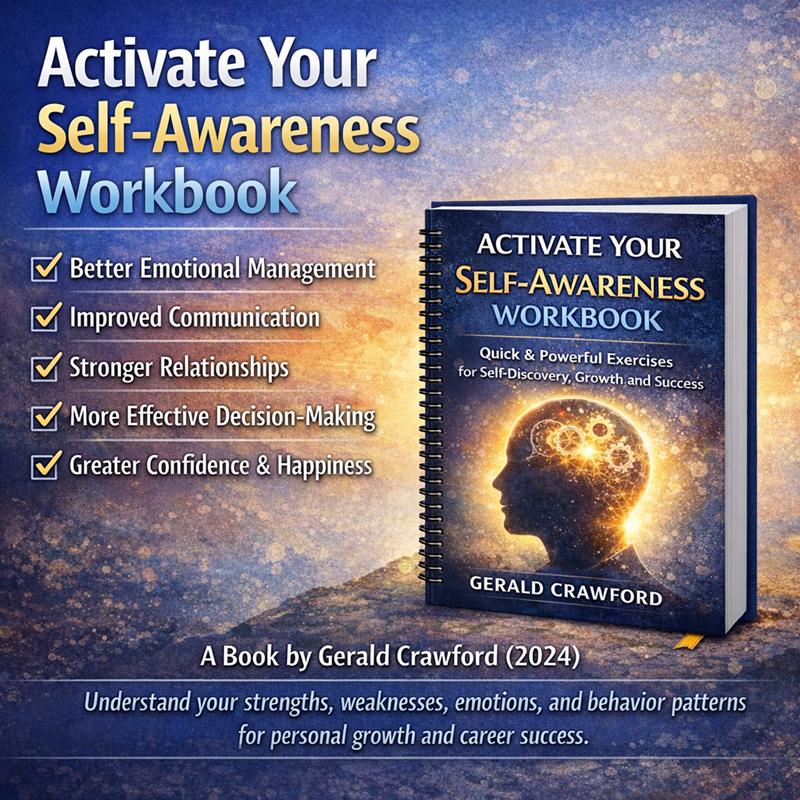
Activating self-awareness leads to better emotional management, improved communication, stronger relationships, more effective decision-making, increased confidence, greater personal happiness, and enhanced career success by helping you understand your strengths, weaknesses, emotions, and patterns of behavior.

Category: Connecting with Your Inner Self (Page 2 of 3)

Final words of encouragement and inspiration from the author Gerald Crawford

Final Words of Encouragement and Inspiration from Gerald Crawford

As you come to the end of this workbook, I want to leave you with a sense of hope, encouragement, and inspiration. Remember that self-awareness is a journey, not a destination. It’s a path that winds and turns, with twists and surprises along the way.

But I want you to know that you have the power to create the life you want. You have the power to choose your thoughts, your emotions, and your actions. You have the power to cultivate self-awareness, self-compassion, and self-love.

Don’t be too hard on yourself if you stumble or make mistakes. Remember that mistakes are an opportunity for growth and learning. Remember that every experience, whether positive or negative, is a chance to learn and evolve.

You are capable of greatness, not just in spite of your flaws and weaknesses, but because of them. Your unique experiences, perspectives, and strengths are what make you special and valuable.

As you continue on your journey of self-awareness, I want to leave you with a few final words of encouragement:

Be kind to yourself: Treat yourself with the same kindness and compassion that you would offer to a friend.

Trust your intuition: Listen to your inner voice and trust your instincts.

Take risks and be brave: Don’t be afraid to try new things and step outside your comfort zone.

Practice self-care: Take care of your physical, emotional, and spiritual needs.

Seek support: Surround yourself with people who support and encourage you.

Remember, self-awareness is a journey, and it’s okay to take it one step at a time. Don’t worry if you don’t have all the answers or if you’re not sure what’s next. Just take the next step, and trust that the universe will guide you.

You got this, Gerald says. You are strong, capable, and resilient. You are worthy of love, respect, and happiness. Keep shining your light, and never give up on your dreams.

Visit https://self-awareness.co.za/ to Stay Connected

Stay connected with me, Gerald Crawford, and the self-awareness community by visiting https://self-awareness.co.za/. Here, you’ll find additional resources, support, and inspiration to help you continue on your journey of self-awareness and personal growth.

Thank you for joining me on this journey, and I wish you all the best on your path to greater self-awareness, love, and fulfillment.

In closing, I leave you with a quote from my heart to yours:

“You are the universe, and the universe is you. You are the spark that sets the fire of love, compassion, and kindness ablaze. You are the change you wish to see in the world. Go out there and shine your light, and never forget that you are loved, valued, and enough.” – Gerald Crawford

Connecting with Your Inner Self – Practicing meditation and mindfulness to connect with your inner self

Connecting with your inner self is a powerful way to gain a deeper understanding of yourself and live a more authentic life. One of the most effective ways to do this is through the practice of meditation and mindfulness.

By cultivating a greater awareness of your thoughts, feelings, and bodily sensations, you can tune into your inner self and access a deeper sense of wisdom, compassion, and guidance.

What is Meditation?

Meditation is a practice that involves focusing your attention on a specific object, thought, or activity to achieve a mentally clear and emotionally calm state. Meditation can take many forms, including mindfulness meditation, loving-kindness meditation, and transcendental meditation. The goal of meditation is to cultivate a greater awareness of your inner self and to reduce stress, anxiety, and other negative emotions.

What is Mindfulness?

Mindfulness is the practice of being fully present and engaged in the current moment, while cultivating a non-judgmental awareness of your thoughts, feelings, and bodily sensations. Mindfulness can be practiced through meditation, but it can also be incorporated into daily activities such as eating, walking, or even doing the dishes. By being more mindful, you can develop a greater sense of awareness, clarity, and inner peace.

Benefits of Meditation and Mindfulness

The benefits of meditation and mindfulness are numerous and well-documented. Some of the most significant benefits include:

1. Reduced stress and anxiety: Meditation and mindfulness have been shown to decrease the production of stress hormones like cortisol, leading to a sense of calm and relaxation.

2. Improved emotional regulation: By cultivating a greater awareness of your emotions, you can better manage your emotional responses and develop a greater sense of emotional intelligence.

3. Increased focus and concentration: Meditation and mindfulness can help you develop greater focus and concentration, leading to improved productivity and performance.

4. Enhanced creativity: By accessing a deeper sense of inner wisdom and creativity, you can tap into new ideas and inspiration.

5. Greater self-awareness: Meditation and mindfulness can help you develop a greater understanding of your values, goals, and motivations, leading to a more authentic and fulfilling life.

Tips for Practicing Meditation and Mindfulness

1. Start small: Begin with short periods of meditation and mindfulness practice, such as 5-10 minutes per day, and gradually increase as you become more comfortable with the practice.

2. Find a quiet and comfortable space: Identify a quiet and comfortable space where you can sit and meditate without distractions.

3. Focus on your breath: Bring your attention to your breath, noticing the sensation of the air moving in and out of your nostrils.

4. Be gentle with yourself: Remember that it’s okay if your mind wanders during meditation. Gently bring your attention back to your breath without judgment.

5. Incorporate mindfulness into daily activities: Bring mindfulness into your daily activities, such as eating, walking, or even doing the dishes, by paying attention to your senses and the present moment.

Simple Meditation Exercise

Here’s a simple meditation exercise to get you started:

1. Find a quiet and comfortable space to sit.

2. Close your eyes and take a few deep breaths.

3. Bring your attention to your breath, noticing the sensation of the air moving in and out of your nostrils.

4. When your mind wanders, gently bring your attention back to your breath without judgment.

5. Continue to meditate for 5-10 minutes, focusing on your breath and the present moment.

Simple Mindfulness Exercise

Here’s a simple mindfulness exercise to get you started:

1. Choose a daily activity, such as eating or walking.

2. Bring your attention to your senses, noticing the sights, sounds, smells, tastes, and textures of the experience.

3. Pay attention to your thoughts and emotions, noticing how they arise and pass away.

4. Continue to practice mindfulness for 5-10 minutes, focusing on the present moment and your senses.

« Older posts Newer posts »
Back a Buddy Show your Support